
Electrification X API overview
Before using the API, follow the Getting Started guide to obtain credentials and create an access token.
Navigation
- Entity relationship diagram
- Hierarchical structure of entities in Electrification X
- Available entities
Entity relationship diagram
classDiagram
direction LR

class User
class Customer
class Partition
class Location
class Asset
class Measurement
class MeasurementValue
class Aggregate

User "N" --> "1" Customer
Customer "1" --> "N" Partition
Partition "1" --> "N" Location
Location "1" --> "N" Asset
Location "1" --> "N" Measurement
Asset "1" <-- "N" Measurement
Measurement "1" --> "N" MeasurementValue
Aggregate --|> MeasurementValue
Hierarchical structure of entities in Electrification X
The entities in Electrification X follow a hierarchical structure: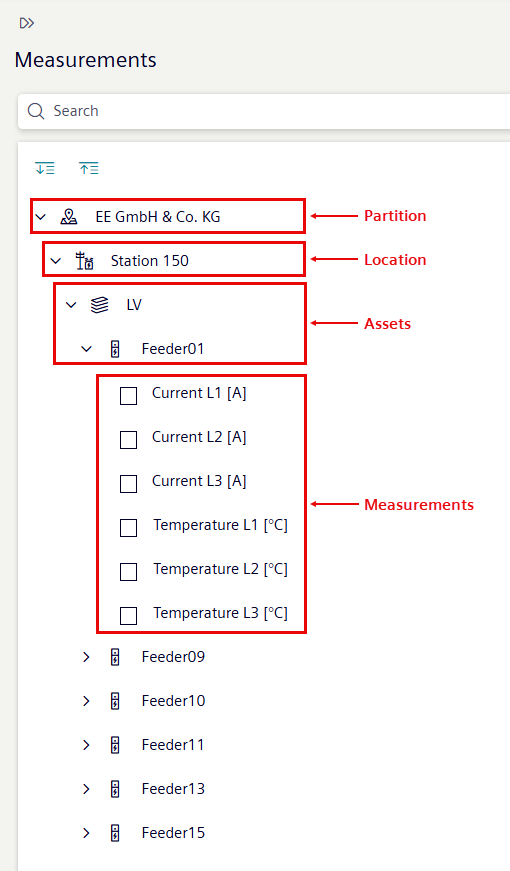
Available entities
User
In Electrification X, a user is a defined entity with specific access rights, roles, and permissions.
Customer
In Electrification X, a customer is a broader entity that represents the organization or entity utilizing Electrification X platform.
Partition
In Electrification X, a partition is a specific defined scope of work, tasks, or operational domain that an individual or team is accountable for.
Location
In Electrification X, a location is a specific site, facility, or geographical point, e.g. a station.
Assets
In Electrification X, an asset is electrical infrastructure and equipment critical for energy distribution and electrification. An asset is a logical unit which can consist of multiple physical devices. Examples for assets are:
- Transformers
- Circuit breakers
- Switchgear
- Feeders
- EV charging stations
Assets are represented in a hierarchical structure within the Electrification X application. In the asset hierarchy, measurement data can be accessed by traversing the asset structure, with each asset providing access to its associated measurement values.
Measurements
In Electrification X, a measurement is a data point that represents a quantitative observation or reading of a parameter, e.g. the ambient humidity of a station.
MeasurementValue
A MeasurementValue holds meta information about a measurement (e.g. unit, description) but does not contain concrete measured values. To retrieve actual values, use the Aggregates endpoint.
Aggregate
An Aggregate is a statistical summary (AVERAGE, MINIMUM, MAXIMUM, COUNT) of MeasurementValues over a time interval. The values are aggregated for the specified start time, end time, and interval. Currently, only a 15-minute interval (PT15M) is supported.
For detailed endpoint documentation, see the API Reference.