
Streaming Data REST API
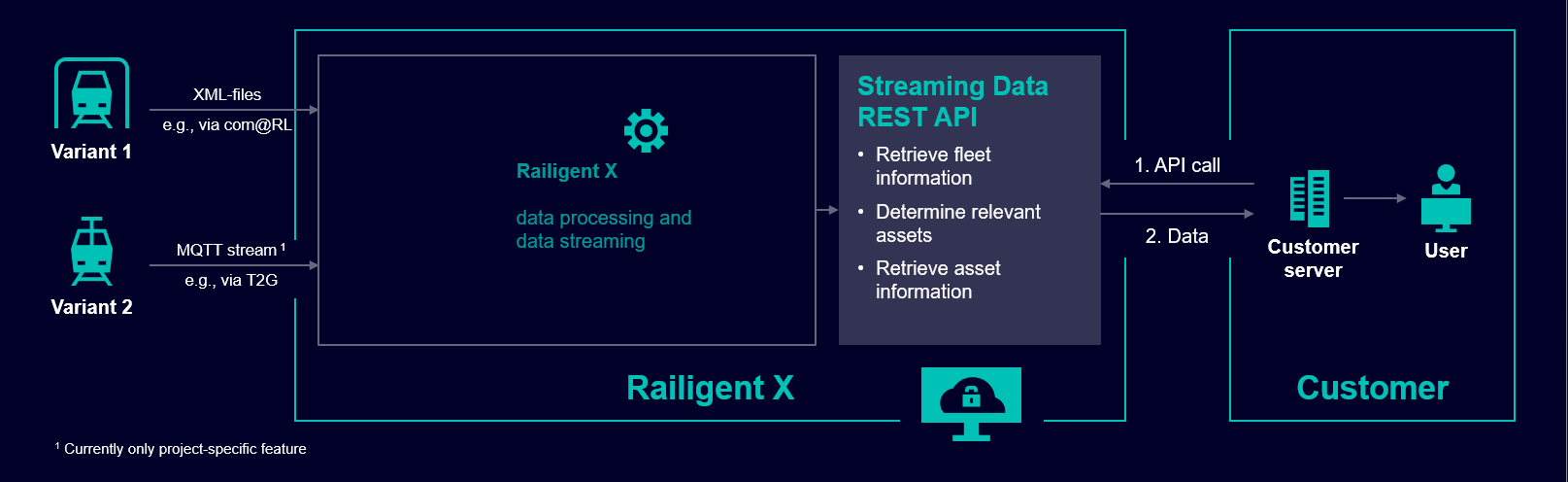
The API provides direct, programmatic access to live data streams from assets in the Railigent X data lake.
This REST API is as a straightforward and powerful tool for building real-time monitoring and data analysis applications. It enables the integration of live asset data directly into existing systems or the creation of responsive solutions.
Railway operators, owners, and lessors receive real-time data from critical onboard systems, enabling continuous tracking and analytics of their rail vehicle operations.
Why real-time streaming via an API?
Following the Data as a Service (DaaS) paradigm, this API gives you a convenient way to receive live information and raw data from your assets in near real-time. This machine-to-machine interface allows you to process continuous data streams directly within your own business applications, tailored to your specific needs.
Pre-processed operational data can be easily integrated into customer systems, empowering you to develop insights and optimize vehicle utilization and maintenance strategies.
We provide a robust, standardized streaming service for developers building real-time monitoring and data analysis solutions.
Your Benefits:
- Enables real-time monitoring of key vehicle data in customer systems
- Choose your own tools. Full flexibility in processing and displaying vehicle data
- Monitor operational behavior, detect outliers, fill data gaps
Available Data Services Packages
The availability and scope of data service packages are determined by contractual agreements and are specific to vehicle types.
Generally, the following data service packages are available:
Note: As a The Live Vehicle Information package provides railway operators and leasing companies with a seamless way to integrate real-time data on the position, speed, and mileage of their rail vehicles directly into their IT systems. Unlike manual data collection or third-party hardware solutions, this API-based service delivers reliable, up-to-date information across all the vehicles in a customer’s fleet, with no additional effort required in workshops or on the vehicles. By easily incorporating critical vehicle data points, users can gain a continuous, near real-time overview of their fleet, enabling more informed decisions and quicker responses to changing conditions. Key benefits of the Live Vehicle Information API include streamlined data integration, improved visibility and responsiveness, and hassle-free implementation. The standard package provides access to key asset data points: position, speed, mileage, vehicle ID, and trip ID, in near real-time. Customers can rely on consistent, accurate information across their entire fleet, regardless of hardware or software version, thanks to the platform's enterprise-grade reliability and security. Occupancy Information is an optional service package for passenger vehicles. It provides the degree of occupancy per saloon, in percent. This package is an optional add-on to Basic Vehicle Information. The Vehicle Status package provides railway operators, owners, and lessors with real-time data from critical onboard systems, enabling continuous tracking and analytics of their rail vehicle operations. Delivered via the Railigent X Train API, this service offers visibility into how assets are being utilized, allowing users to optimize vehicle deployment and inform data-driven maintenance planning. Unlike installing third-party hardware, the API-based solution simplifies data access by providing pre-processed operational data that can be easily integrated into existing systems. Key benefits of the Vehicle Status package include enhanced operational efficiency, improved vehicle utilization, and streamlined data integration. Railway operators and vehicle owners can analyze usage patterns to plan maintenance and circulation, while dispatchers and rental companies can leverage historical data to optimize fleet deployment. The flexible, scalable, and secure platform allows customers to seamlessly incorporate vehicle status information into their own analytics and reporting tools. Subset of available data: The Vehicle Counters package provides railway operators and leasing companies with a data service that delivers the current values of maintenance-relevant counters from their rail vehicles. This information allows users to plan data-driven maintenance by gaining visibility into the operation hours and switching cycles of critical components, rather than relying on time-based schedules. For dispatchers and rental companies, the historical counter data can also be leveraged to inform the efficient allocation and circulation of the vehicle fleet. Key benefits of the Vehicle Counters package include optimized maintenance planning, enhanced fleet utilization. Unlike manual data collection or the installation of third-party hardware, the API-based solution provides accurate and up-to-date counter information with minimal effort required on the customer's part. Subset of available data: The Vehicle Config Data Package provides rail operators with a centralized source of comprehensive vehicle data to support informed decision-making and efficient fleet management. The package documents the vehicle's key technical specifications, including maximum speed, starting traction, and braking force, which can be valuable for optimizing operations and maintenance. The package covers essential vehicle master data, such as the UIC number, vehicle variant, and the latest software release available for that specific model. At the core of the package is a detailed list of the hardware and software versions currently installed on the vehicle's RDA (Remote Diagnostic Access) box. This information is complemented by a "Target/Current Analysis" (TCA) report, which identifies any deviations between the target software release and the versions currently running on the vehicle. This analysis helps pinpoint vehicles that may require software updates. For vehicles where Siemens is responsible for service, the package includes the target software release, enabling a direct comparison to the actual installed version. Subset of available data:Vectron customer, all your agreed-upon data is accessible independently of specific service data packages.Live Vehicle Information
Occupancy Information
Vehicle Status
Vehicle Counters
Vehicle Config Data
Deprecation Policy
In the course of product and feature development at SMO, the API may evolve. We want to ensure that customers receive the information they need to take advantage of these features, and to update their systems in time. Features from previous releases may become deprecated with a new feature release (“breaking change”). SMO will notify API customers ahead of the release date, and ensure six months of backward compatibility. Examples of breaking changes are:
- Changes to endpoint URIs
- Changes in the API´s request / response structure
- Changes in HTTP methods used
Important Considerations
To ensure a stable and reliable experience for all users, please be aware of the following policies.
- Data Retention: Data within a stream is retained for a specific period. Be sure to retrieve the data you need within this retention window, as older data may not be available through the streaming interface.
- Service Usage Limits: The API is subject to usage limits to ensure fair use and system stability. These limits may apply to the number of consumers, subscriptions, or the frequency of data retrieval requests.